Members
Supreme Court allows failed candidate to sue chief electoral officer
Case dates back to Alberta’s 2015 provincial election and involves claims of acting in bad faith
BY Dale Smith 19 Jun. 2026

Log in to listen to this article
The Supreme Court of Canada has allowed a failed candidate in Alberta’s 2015 provincial election to sue the chief electoral officer, amid claims he acted in bad faith when he took issue with improper candidate signs.
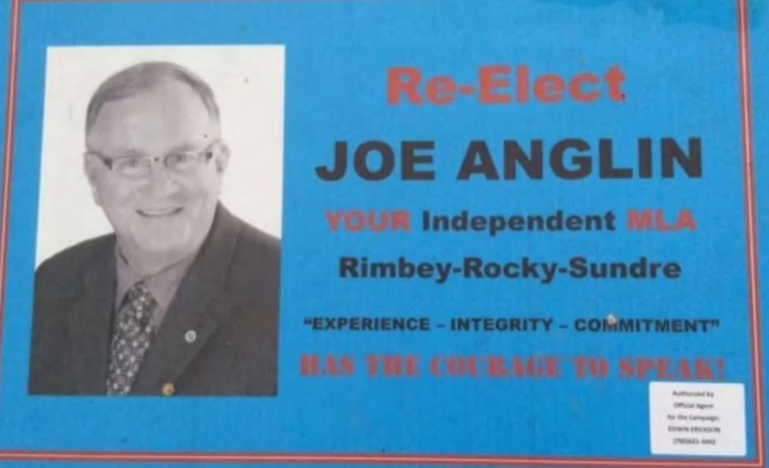
Joseph Anglin was an MLA in Alberta from 2012 to 2015, and lost his seat in the historic election that saw Rachel Notley’s NDP form government for the first time in the province’s history.
During the campaign, Chief Electoral Officer Glen Resler investigated Anglin for candidate signs that identified him as an MLA — a title not valid with the dissolution of the legislature for the election — and because the sponsorship information on them was smaller than the prescribed size. At least 25 of Anglin’s signs were removed as a result of the violations. He was also given a $250 administrative monetary penalty for the sponsorship information size issue.
After the election, Resler appointed an investigator when a member of the public found a copy of the voters’ list linked to Anglin. When that probe concluded, he fined Anglin $500 for failing to take reasonable steps to protect the list. Anglin challenged both penalties in court. While the $250 penalty was upheld, the $500 penalty was rescinded because Resler failed to provide Anglin with a copy of the investigator’s report.
Anglin then took civil action against Resler, claiming malicious prosecution, misfeasance in public office, and trespass of chattels. He sought damages for loss of chance. Resler filed a motion to strike the statement of claim on the grounds that it was frivolous, irrelevant or improper. At trial, the judge struck the claim in its entirety, finding it to be an abuse of process.
However, the Alberta Court of Appeal granted the appeal and largely restored the statement of claim, minus the malicious prosecution claims. Resler appealed to the Supreme Court of Canada.
Anglin’s lawsuit valid
While the Court unanimously dismissed his appeal, finding nothing to prevent the lawsuit from proceeding, the reasoning differed, with a 6-3 majority upholding the Court of Appeal’s decision. However, the Court broke down into a 4-2-3 set of reasons: four in the majority, three dissenting in part, saying they would also have struck the claim for loss of chance, and two concurring with the majority but adding a response to the partial dissent.
The Court was unanimous that, because Anglin's claims were for monetary damages, did not seek to overturn the election results, and were separate from the previous judicial reviews, the lawsuit was valid. Further, the suit did not trigger parliamentary privilege. Nor was it statute-barred because that only affects claims when the chief electoral officer operated in good faith, which Anglin claims Resler did not.
“Having found that the claim is not barred by the doctrines of collateral attack or abuse of process, or any privilege or immunity, and that the allegations and facts pleaded disclose a reasonable claim, I agree with the Court of Appeal majority reasons reinstating the amended statement of claim with the exception of the allegations of malicious prosecution,” Justice Mary Moreau wrote for the majority.
“Anglin may proceed with his civil claim against Resler with the exception of the malicious prosecution claim that was struck and that was not the subject of a cross-appeal.”
Writing for the partial dissent, Justice Andromache Karakatsanis took particular issue with the fact Anglin was seeking as $400,000 in damages for the loss of chance claim, which is the salary he would have earned as an MLA over four years if successfully re-elected.
“Loss and chance damages are only available when a plaintiff can prove their lost chance is real and significant, rising above mere speculation,” she wrote.
“Because election forecasts hinge on imperfect polls and shifting public sentiment, any judgment on a causal link between wrongdoing and a candidate’s lost prospects is so uncertain as to be overly speculative.”
Karakatsanis added that a loss-of-chance claim indirectly calls into question the validity of the election result, which Anglin claimed he was not challenging. She would have struck that part of the claim.
In his concurring reasons, Justice Malcolm Rowe, along with Justice Côté, agreed with the majority but responded to Karakatsanis to say the Court should not have weighed in on the loss of chance issue, as they didn’t have enough evidence before them. It’s something best left to the trial court.
Connor Bildfell, a partner with McCarthy Tétrault LLP in Vancouver, who was not part of the case, says the decision is important because it reinforces the need to ensure that appropriate civil remedies are available against public officers who misuse their powers.
“There has long been this debate around how we balance the need to ensure appropriate civil remedies are available against the need to ensure that public officers are not subject to undue attacks on the conduct and decisions that they make in the course of carrying out their duties,” he says.
Here, the Court is saying that the interests of ensuring accountability among public officers and ensuring victims have appropriate recourse for losses they suffer, militate in favour of maintaining the ability of unsuccessful candidates to bring a civil claim.
“It’s a decision that strikes a balance that reinforces the need for public accountability and compensation for victims of misuse of public powers,” Bildlfell says, referring to the part of the decision the Court was unanimous about.
A reminder immunity has limits
Guy Giorno, a partner at Fasken Martineau DuMoulin LLP in Toronto and leader of the firm’s political law section, wasn’t involved in the case, but says it’s noteworthy that the Court was unanimous in saying that allegations of bad faith can get around the statutory immunity of good faith actions.
“It’s an important reminder to everybody who exercises a public function, including those who are regulators, whose job is to enforce and uphold statutes,” he says.
“It’s just an allegation (here), but if you act in bad faith, if you act outside your mandate, if you act for an improper purpose, you could be liable in tort. You can be liable for civil damages.”
For everyone with an immunity provision, it’s worth remembering that it has boundaries and that the tort of misfeasance in public office still exists, Giorno says, noting Alberta’s legislation, much like the Canada Elections Act, keeps good faith as an important ingredient of statutory immunity.
“My hope is that legislatures and parliaments won’t run and erase good faith from these immunity provisions,” he says.
When it comes to the issue of loss-of-chance damages, which is important, he says the majority opted to leave it for another day, so it’s an area that remains unsettled.
“I understand the dissent’s natural inclination to decide that issue. But at the same time, the majority felt this was not the right case to decide that issue," Bildfell says.
"You often see the Supreme Court pulling back and saying that this particular case is suitable for deciding certain issues but not other issues, so we’ll leave those other issues for another day."
As for damages for the loss of chance, Giorno says Justice Karakatsanis' view may eventually end up being the position of the Court when it’s considered on its merits. The issue here was that the Court couldn’t deal with it because it hadn’t been argued.
He says that while Rowe’s concurrence is probably right, Karakatsanis has experience in government as a deputy attorney general and as a regulator, so her perspective is important in cases like these.
“She does bring that knowledge of how things really work, and what the implications of decisions are,” Giorno says.
The decision comes at a time when there have been high-profile challenges to election results both in Canada and the United States.
“(It’s) playing out in a particular political context,” he says.
“These are all very topical, timely issues that the Canadian public is very interested in.”