Membres
Approaching the bar
Law students on evolving legal roles and real-life issues making their way into the classroom
PAR Madalyn Howitt 10 juin 2026


Connectez-vous pour écouter l'article
Maria Kalapurayil’s journey into law probably began before she was born. Her parents were lawyers in India, and met in law school.
Despite this, Kalapurayil says law wasn’t something she ever thought about growing up. At least until Grade 11, when she took a job as a page at the Alberta Legislature. That’s when her interest in all things legal finally started to emerge.
“That really exposed me to the world of social justice, politics, and social issues. It was kind of like a eureka moment where my eyes opened, and I realized that this is what I was called to do and this is what I was meant to do,” she says on the season finale of the Verdicts & Voices podcast.
Kalapurayil has just graduated from law school at the University of Alberta in Edmonton and is picking up where her parents left off. When she was six, her family moved to Canada with the hopes of practicing law again in their new home.
“My mom had tried to pursue her legal career here and tried to go through the accreditation process here, [but was] unfortunately unsuccessful. It was really inaccessible at that time for a young immigrant family,” she says.
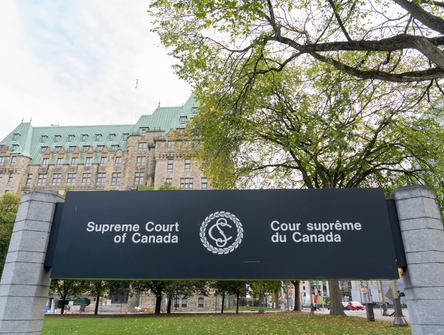
Growing up in Gatineau next door to Ottawa, Justine Morin-Laporte’s school trips took her to Parliament and the Supreme Court of Canada.
“It always sparked some kind of curiosity in me, the fact that from those institutions, the laws or the decisions that were made could have an impact not only on individual rights but across the country,” she says.
Morin-Laporte is the president of the student section of the Quebec branch of the Canadian Bar Association and heading into her third year of law school this fall at L'Université de Quebec. She says her first foray into the workforce drove home the importance of fighting for workers’ and human rights, which was a big part of what set her on a legal path.
“As a young teenager, when it's your first work experience, you're not necessarily aware of your rights in terms of schedules, hours, (or) protection against harassment. (For) the first time I really realized that our rights sometimes have to be fought for,” she says.
For Sophie Poitras, who’s heading into 2L at the l'Université de Moncton in New Brunswick, the law bug got her during her undergrad, when she learned about the development of legal systems throughout history and the importance of the rule of law.
“I participated in a moot … and I really enjoyed that experience,” she says of the mock appellate court hearing.
It’s no fluke that the three guests on this episode are all women. They say there are many more women in their law school classes than men. Out of a small class of 35 or 40 students, Poitras says fewer than 10 of them are men. That’s certainly a shift from decades ago when law was a male-dominated field.
“I think there's like a tendency in academia that more women are being encouraged to pursue higher education. It's really amazing to see, and I think that's probably why there's a lot of women in law school,” she says.
Morin-Laporte attributes this to younger generations growing up with less rigid ideas about which careers are for men and for women.
“I think in that way we were more likely to choose based on our aspirations or ambitions.”
That said, the greater prevalence of women doesn’t seem to carry through in law firms.
“I don't think that trend necessarily continues on when we go into the professional career, whether that be through academia or through a legal profession in practice,” Kalapurayil says.
“Hopefully, that trend over time can continue to dissipate into those higher spaces as well.”
Morin-Laporte says she’s been noticing a significant shift away from the traditional view of a good lawyer or professional.
“I think that this idea, this constructed perspective of the ideal lawyer, is slowly changing.”
For instance, lawyers are content creators on social media, dressing more boldly, and shifting the social traditions of law firms from after-work drinks to associate lunches to better accommodate working parents. Kalapurayil says all of this is helping to shift attitudes in the profession.
Poitras agrees that legal careers are evolving.
“There's an idea that lawyers are very rigid, like it's a rigid profession. But I think that's not necessarily true. I think there's more fluidity in the career."
Being a law student and young lawyer during politically tense times is an intriguing opportunity to dive into the rule of law and the principle of judicial independence, which are increasingly under attack. Kalapurayil is coming into the field as questions about Alberta’s future in Canada have many on edge.
“It really feels like you're in it, you know, because a lot of the voices around it, whether it comes to speaking up against it or providing insights around it, are the people who are teaching my classes,” she says.
“It feels much more intimate than maybe the distance you feel when you read something in the news.”
Real-world legal issues are suddenly less abstract when they make their way into a law classroom.
“It doesn't really feel anymore like something I'm reading about. It feels like something I'm thinking about and something I get to actually put into practice,” Kalapurayil says.
“I’m really excited, despite the background of what's happening, to see how the legal field responds to these threats.”
Listen to the full episode to hear our guests’ thoughts on where the profession is headed, and what their personal next chapters in law will look like. And stay tuned for season four of Verdicts & Voices launching in September!