Membres
Strength of rule of law not measured in calm waters, says chief justice
Increasing threats to democratic institutions dominate Supreme Court of Canada’s opening
PAR Dale Smith 05 octobre 2026

Connectez-vous pour écouter l'article
Supreme Court of Canada Chief Justice Richard Wagner says we need to find new ways to protect our democratic institutions in this country.
“The pressures facing (them) are unrelenting,” he told those gathered Monday at the ceremonial opening of the judicial year.
Comparing democratic institutions to an anchor that keeps us from drifting when the seas grow rough, Wagner noted the strength of an anchor isn’t measured in calm waters.
“It is measured in a storm. The same is true of the rule of law.”
In an increasingly complex world, Canadians cannot lose sight of the fundamental principles of the justice system, nor the reasons for confidence in its institutions.
“We have strong institutions,” Wagner said.
“We have people who believe in them. And we have the capacity to meet the challenges ahead.”
The ceremony was held in the Court’s new temporary location in the West Memorial Building, across the street from the Court’s permanent Ottawa home, which is undergoing a decade-long renovation and rehabilitation.
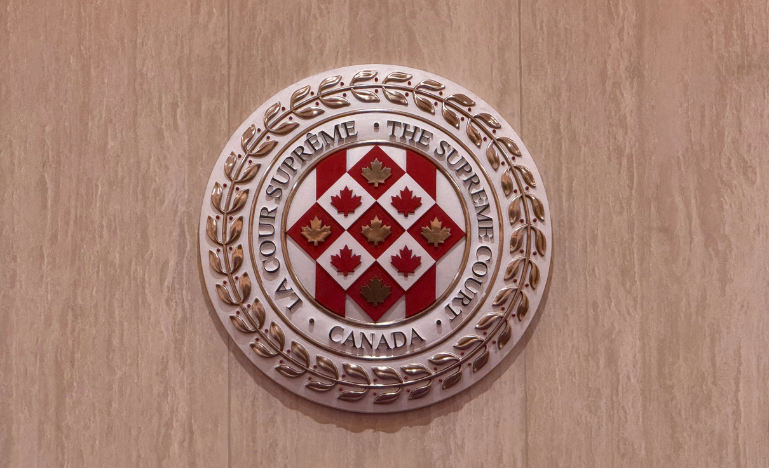
For the first time, the new courtroom displays the Court’s heraldic emblem on the wall behind the justices, who are represented by nine arches in the room and will sit on chairs that came across the street with them — one of the hallmarks of continuity between the two buildings.
The opening marked the first sitting for new Justice Glenn Joyal, though his official welcome ceremony won’t be held until late November.
Federal Justice Minister Sean Fraser joked that, as his first appointment to the top bench, he has many expectations for Joyal, who admittedly has come to the Court at a turbulent time. Fraser said the changes Canadians are experiencing might have been unfathomable just a few years ago — and not all of them are the work of external forces.
“This conversation about unity takes place at a time where provinces, communities, and people are asking questions about their role within the federation,” he said, noting that if we expect to preserve national unity, we must constantly prove to people that our systems and institutions serve their interests.
The law and courts play an important role by providing certainty and providing a truth-seeking function in the age of AI and misinformation.
“We are so lucky to be a country of laws, to be willing consistently over generations to do things the hard way, because we know it’s the right way,” Fraser said, noting it’s been nearly a century since the living tree doctrine came into Canadian law.
“If we’re to accept that doctrine as part of the laws of this nation, we must similarly accept the obligation placed upon us as caretakers of that tree. As the branches grow, sometimes in unruly ways to address the changing nature of modern reality, I know and take great comfort in the fact that the Court will be here to ensure its roots remain strong for a generation to come.”
Speaking on behalf of the Canadian Bar Association, past president Bianca Kratt said that during her time at the helm, she watched as disagreements with court decisions easily slipped into animosity directed at the decision maker, amid demands that case outcomes align with public sentiment or government preference.
“Judicial independence is a hard principle to defend because judicial restraint generally prevents judges from engaging with public criticism,” she said.
“Judges can speak as far as their role permits.”
Kratt pointed out that in January, the three chief justices in Alberta had to issue a statement after Premier Danielle Smith expressed her desire to “direct” them.
“It is up to the rest of us to respond when judges are attacked,” Kratt said.
“It is our collective responsibility as a legal community and as citizens of a free society, whatever our position, and whatever our politics, to promote and defend judicial independence, especially when it’s not popular to do so.”
We’re at a moment in history when the essential functions of the justice system are under attack, and some are eager to chip away at the rule of law, said Craig Ferris, president of the Advocates’ Society.
“As this Court so powerfully said in the Succession Reference, democracy in any real sense cannot exist without the rule of law. We must do more than simply uphold those principles in our courts.”