Membres
Ripples beyond the law
For Antoine Collins, giving back is a chance to honour those who brought him along
PAR Sue Bailey 15 juillet 2026

Connectez-vous pour écouter l'article
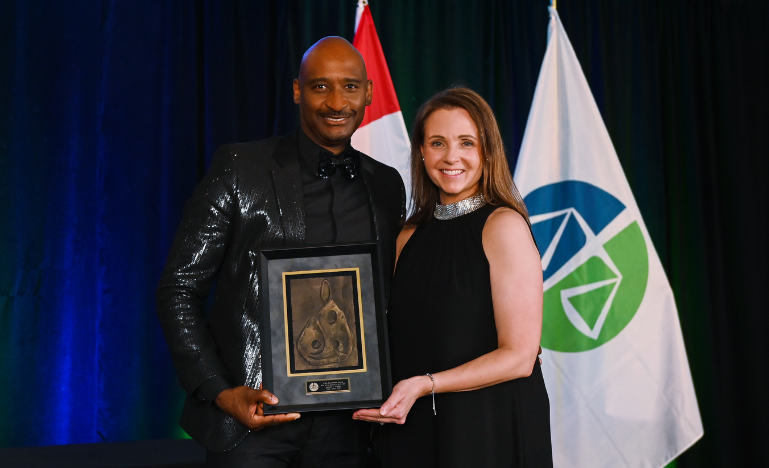
For Antoine Collins, giving back is not just about professional goodwill or charitable duty. It’s personal.
This year’s winner of the Canadian Bar Association’s Touchstone Award for promoting equality credits Mama Pearl, the woman who raised him with love and music in Gary, Indiana.
“Growing up the way I did in the foster care system gave me perspective,” says Collins, an adjudicator in the Immigration and Refugee Board of Canada’s Refugee Protection Division in Ottawa.
“It taught me empathy. It taught me early on that people carry stories. You never know how that shapes their lives.”
He devotes himself to mentorship because it’s the best way he knows to bring less represented members into the legal profession and help them stay. It’s also a chance to honour those who brought him along.
“I think that we need diverse voices at the table to make sure that we can sustain and strengthen the rule of law. You need those people in the rooms that you’re not in to talk you up.”
Tough love is also crucial, says Collins, who graduated from the University of Illinois Chicago School of Law and was called to the bar in Maryland in 2002.
“I think that’s what we need to succeed, not only within the law but within most careers – and life.”
‘A difference that ripples beyond law’
Starting out as an assistant state’s attorney in Baltimore, Collins recalls how the twin scourges of drugs and crime pitted the blind pursuit of convictions against more compassionate approaches – including a dire need for social services.
“You had to ask … how did this individual get into the situation that they’re in? That’s always a defining moment for me, being a lawyer who is in touch with humanity.”
He was called to the Ontario bar in 2011 after immigrating to Canada with his partner in 2009.
Ashley Butts, senior legal counsel at BDO Canada, nominated Collins for the Touchstone Award because he’s made a difference that ripples beyond the law.
“His work on issues related to race, gender, and sexual orientation has made a significant impact, championing the cause of equality within the legal profession and inspiring others to follow his lead,” says her letter of support.
His efforts make Ontario “a better place for everyone.”
Those contributions include a comprehensive work plan that Collins developed to make the Refugee Protection Division more inclusive. It has since become part of national management training.
He helped create the Canadian Association of Black Lawyers’ mentorship program for 2SLGBTQI+ legal professionals and students.
While leading CABL’s Ottawa chapter, Collins also founded the Brother's Corner: Black Men in Law Collective to offer support and connection.
Next year, he will become the first Black president of the County of Carleton Law Association.
“When Antoine identifies a gap, he responds with action,” says a letter of support signed by Kyle Elliott, diversity and inclusion counsel at Blakes, and Raphael Tachie, a partner at Dentons.
Despite progress, “Black male lawyers in the NCR (National Capital Region) continue to encounter systemic barriers, limited access to informal sponsorship networks, and isolation across private practice, government, academia and in-house roles,” it says.
Collins is now writing Honourable Voices: A Chronicle of Canada’s Black Judiciary. It traces the careers of 79 Black judges, starting with Justice Maurice Charles in 1969.
The project is a follow-up to the 2022 collaborative book, Canada’s Black Judges and Justices: Past – Present – Beyond.
Collins has counted 56 Black judges serving on courts across the country today.
He hopes that in future those numbers will include the Supreme Court of Canada, and that Black lawyers will increasingly apply to the bench.
Having more people of colour in the judiciary is a powerful beacon for the next generation, he says.
“You can’t aspire to something you can’t see.”
Music and Mama Pearl
A singer-songwriter who has released several jazz recordings, Collins says music has been a vital part of his life since growing up in the Black church.
“The law speaks to structure and principle, and music speaks to humanity and emotion. For me, I need them both.”
Collins was born to a 15-year-old girl who was herself in the foster system.
She would later have visitation rights, but Collins gratefully describes the stable home and words of wisdom he got from his foster mother, Pearline Coleman, known as Mama Pearl.
“The things you do in the dark will always come to light,” she would say.
And: “If you don’t believe in something, you’ll fall for anything.”
Collins wrote the song “Ella” on his most recent album, Dinner at Antoine’s, as a tribute to the strong women in his life, including Mama Pearl.
“If it wasn’t for you, there would be no me,” he sings. “Always on my mind, thinking how you encouraged me.”