Membres
An equality seeker and truth teller
Retiring Supreme Court of Canada Justice Sheilah Martin honoured with President’s Award from the CBA
PAR Holly Lake 05 juin 2026

Connectez-vous pour écouter l'article
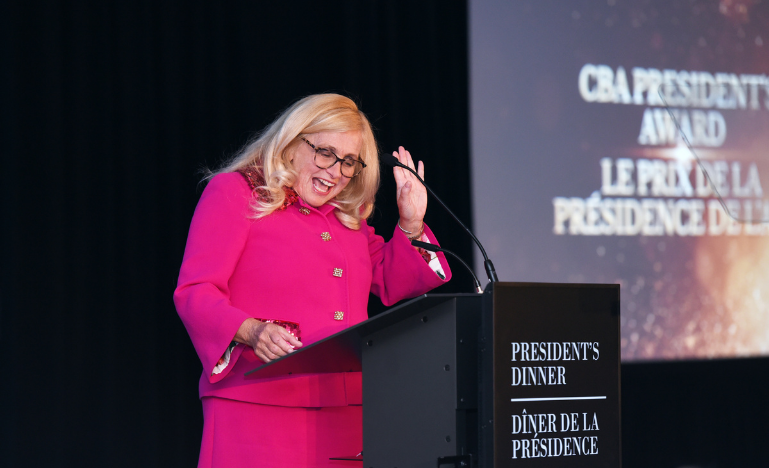
In her first speech since retiring from the Supreme Court of Canada on May 30, former Justice Sheilah Martin said that people might be wondering about “what delicious, delightful pieces of information” she’ll disclose now that she’s “unshackled by principles and judicial restraint” and “outside the jurisdiction of the Canadian Judicial Council.”
But she warned those gathered as she accepted the President’s Award from the Canadian Bar Association Thursday night in Ottawa that they might be disappointed.
“The answer is brief, and maybe a bit boring,” Martin said.
“I want to continue to use my voice to correct injustice, to bring about positive change, and pursue the simple and constant goals that underpinned all of what I sought to do in my life. That is to contribute to help Canada be a better place, a place subject to the rule of law, where equal justice for all was a cornerstone, and on which a strong, stable, and civil society rested.”
As an equality seeker and truth teller, Martin used to joke that there were only two reasons she’d never be a judge: everything she ever said and everything she ever did.
“I was wrong about that, in part because of the efforts to change our laws, our legal institutions, our attitudes, and the representative capacities of our legal profession. In this, we were at least in part successful.”
In presenting the award, CBA President Bianca Kratt said Martin’s impressive record of achievement and service in academia, private practice, and community engagement made her worthy of the recognition even before she was appointed to the bench.
Martin began her career as a law professor at the University of Calgary and served as dean for five years. She moved on to private practice, specializing in criminal and constitutional litigation, and took on pro bono cases of profound social importance for the Women's Legal Education and Action Fund and the Alberta Association of Sexual Assault Centres, all the way to the Supreme Court.
She helped David Milgaard secure compensation for his wrongful conviction and was an expert witness at the Thomas Sophonow Inquiry. At the invitation of the Assembly of First Nations, she was part of the legal team that worked towards the Indian Residential School Settlement Agreement.
In 2005, Martin was appointed to the Court of Queen’s Bench for Alberta. Eleven years later, she was appointed to the Courts of Appeal of Alberta, the Northwest Territories, and Nunavut. A year into that role, she was appointed to the Supreme Court of Canada.
Kratt noted her fellow Calgarian is renowned for retaining her warmth and humility throughout her rise to the upper echelons of Canadian legal practice.
“We spend so many hours of our lives at work and in law that they cannot help but shape who we are,” Martin said.
Learning to fight
Her involvement with the CBA started early in her career. It’s what helped her learn to fight.
“Not fight as in a violent struggle, even though elbows can be up, but fight as a struggle, a contest, a conflict between opposing forces and principles and ideas, a verbal disagreement or debate, a quarrel, fight as a figurative element, a campaign, or a determination to achieve an objective, resist adversity, or overcome a difficulty,” Martin said.
“I’ve watched the CBA fight over decades and have seen that you have helped make change possible. And when I read the current mission statement, I see a lot of alignment with things I worked on with the CBA, and also outside the CBA. We all sought to improve the law and the administration of justice. You improve and promote access to justice by promoting equity, not only in the profession but in the system as a whole.”
Martin worked on the landmark 1993 report, Touchstones for Change: Equity, Diversity and Accountability, which exposed discrimination in the legal profession and sought to shatter the glass ceiling for women. As a young lawyer, she was there for the initial debates and on the floor the day it was released. The report was produced by the Canadian Bar Association’s Task Force on Gender Equality, led by Justice Bertha Wilson, the first woman appointed to the Supreme Court of Canada. It identified barriers to entry into law school and a “poisoned” atmosphere in the schools; barriers to securing articling positions; as well as barriers to women’s success in private law firms and the judiciary.
Along the way, Martin also wrote about the duty to accommodate pregnant lawyers. She said being a working mother taught her plenty about different experiences and what we can learn from them.
“I learned a lot about multitasking. It also allowed me to look at someone, whether a lawyer or a judge, when they were behaving badly and acting out. I just thought they needed a nap.”
Whether it’s Truth and Reconciliation initiatives, minority language rights, or the rights of the LGBTQ community, Martin said the CBA has a list of accomplishments “as long as the inequalities that underpin them.” One of the organization’s strengths is recognizing that education is key to talking across differences and to ensuring we understand each other in increasingly polarized communities.
While she’s lost count of the number of terrible lunches she’s had at CBA section meetings, they were ultimately worth it to represent the profession and promote the interests of members.
Martin thanked Kratt for her “eloquent warnings” about the dangers of delegitimating judges and for urging Prime Minister Mark Carney to resist the politicalization of judicial appointments.
“The courts cannot speak for themselves, and we have long relied on the quality of submissions that the CBA has provided in defence of our common goals.”
She also pointed to the new fights on the horizon — an evolving landscape, new technologies, shifting expectations, and expanding responsibilities.
“Many of the core precepts that we have come to accept as givens or as certainties are under attack or have been rejected,” Martin said.
“Fundamentally, the assumption that the trajectory of all nations is towards democracy, freedom, and equality has proven to be more hope than history. Recent events demonstrate that democracies fail, freedoms are fragile, and equality is frail. Tyranny can triumph. Authoritarianism is on the rise, and there is growing polarization of society, and the rise of deeply anti-egalitarian movements placing pressure and attacks on the independence of the judiciary and the bar.”
This all comes amid a loss of trust in institutions and a general erosion of confidence that’s part of a broader crisis of grievance, in which citizens feel underserved by the systems meant to support them. The problem, she said, is compounded by constant access to fragmented information that produces confusion rather than clarity.
As a result, scrutiny and democratic oversight have never been more important. Ditto for working together to protect the rule of law.
'Deep and genuine gratitude'
Noting this might be one of her last opportunities to thank the CBA publicly, Martin expressed her “deep and genuine gratitude” for the work that’s been done and for the future efforts to fulfill the association’s "inspiring" mandate and vision.
“Put simply, as individual members of the CBA, you understand that the rule of law does not protect itself. You have an unbelievable breadth and diversity of lived experience, and you've mobilized effectively, often in ways big and small, to make a difference,” she said.
“Thank you for being a diligent guardian of the rule of law, judicial independence, and the independence of the bar…You've not only helped shape a legal system, you've touched people, you've touched real lives, you've touched me. Whether as an academic, a lawyer, or a judge, you've helped shape the legal universe in which I've worked and provided me with opportunities to contribute to that universe.”