Membres
What’s on the docket?
Here’s a round-up of the Supreme Court of Canada cases we’re watching this fall
PAR Madalyn Howitt 07 octobre 2026

Connectez-vous pour écouter l'article
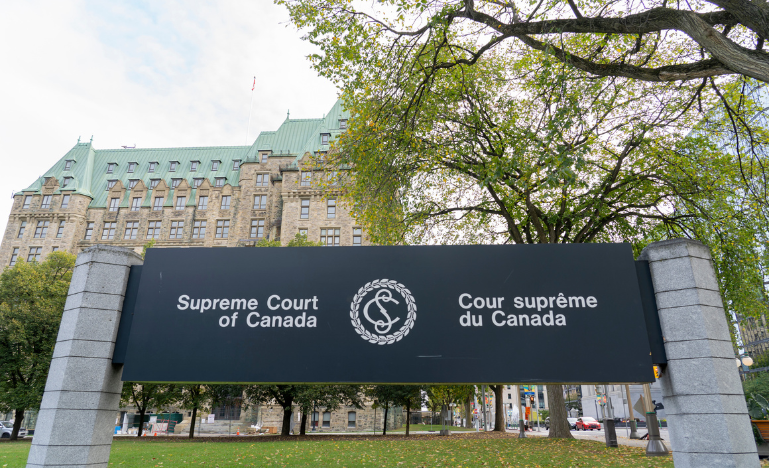
Prison lockdowns, the federal assault weapons ban, and the theft of a Winston Churchill portrait are among the issues that will come before the Supreme Court of Canada this fall. On the latest episode of Verdicts & Voices, court-watcher Nadia Effendi, a partner at BLG in Toronto, takes us through the cases she’ll be following.
Atlantic Lottery Corporation, et al. v. Attorney General of Ontario
Ontario's current iGaming model is managed by private operators and is limited to players physically located in the province. But the government has proposed adding an international liquidity pool that would allow Ontario players and other participants in peer-to-peer games or betting tools to compete with international players, while continuing to exclude players located elsewhere in Canada.
“The Criminal Code has an exception that permits online gaming and betting involving players located in Canada, as the province conducts and manages the lottery scheme that is in that province,” Effendi says.
“The whole question in this case is what is the definition of ‘in that province?’ A majority of the Ontario Court of Appeal found that what the province was proposing to do was compliant with the exception, and that the scheme would be in that province, so that's what these lottery corporations are taking on. They argue that in that province, it ought to have a stricter territorial limit.”
NHK Spring Co., Ltd., et al. v. Tony Cheung, et al.
Focused on price-fixing, this case arose from a national class action brought against foreign manufacturers of hard disk drive suspension assemblies. This internal electromechanical part holds a hard drive in computers and gaming consoles.
The respondent alleges that the manufacturers participated in a global cartel that inflated the price of suspension assemblies sold outside Canada, which were later built into hard drives and consumer electronics purchased by Canadians, consumers, and businesses.
“The Court will determine here whether Canadian courts can assume jurisdiction over an alleged foreign price fixing class action on the basis that the price fixing conspiracy had effects within Canada,” Effendi says.
“Specifically, the Court is really asked to interpret the Competition Act [and] can it be used to recover civil damages for an alleged conspiracy formed and implemented abroad.”
John Vabuolas, et al. v. Information and Privacy Commissioner for British Columbia, et al.
This is a unique case concerning access to information about Jehovah's Witnesses and whether freedom of religion can be trumped by an individual's privacy concerns.
“The question before the Court is really about the boundary between privacy rights and religious freedom,” Effendi says, adding that the outcome of the case could have broad implications.
Two former Jehovah’s Witnesses filed access requests, seeking disclosure of their personal information held by their former congregations. Their requests were refused on the grounds that the records contained “privileged and confidential religious communications.” The complainants went to the privacy commissioner, who ordered the production of those documents.
“The commissioner, the lower court, and the Court of Appeal all concluded that the access regime could be applied consistently with the Charter, with the Court of Appeal holding that any religious freedom concern could be properly balanced by an administrative discretion under the infamous Doré framework,” Effendi says.
“The congregation argues that you need to apply the Oakes test instead of Doré.”
Durrell Diggs, et al. v. Attorney General of Nova Scotia, et al.
This case involves a habeas corpus application by two inmates on remand at the Central Nova Scotia Correctional Facility. At the time they were in custody, the jail was experiencing significant staffing shortages, resulting in rotational lockdowns in which inmates spent substantially more time confined to their cells than the usual 10 to 12 hours of daily out-of-cell time. The inmates allege that these lockdowns were unlawfully depriving them of their residual liberty.
“The Court’s going to have to undertake and determine the scope of habeas corpus, which requires a public authority detaining a person to bring them before a court to justify the legality of their detention,” Effendi says.
“If the detention is found to be unlawful, then the court must order their release.”
The Court will have to decide whether habeas corpus can be used to review institution-wide and operational policy decisions, such as staffing shortages, or whether it is confined to very discrete individualized detention decisions. That will obviously affect the use of the writs in the prison context.
Canadian National Railway Company v. Alberta Pacific Forest Industries Inc.
This appeal concerns whether CN can obtain judicial review of factual findings made by the Canadian Transportation Agency, and whether section 18.5 of the Federal Courts Act, together with section 40 of the Canada Transportation Act, bars judicial review.
“I'm paying close attention to this one in part because I'm counsel for the appellant, Canadian National Railway, in this case,” Effendi says.
“But it's also a very fascinating case about admin law and the right to legality review and the doctrine of adequate alternative remedies.”
This case builds on the Court's recent decision in Democracy Watch, where it found that the Constitution guarantees legality review of all aspects of administrative decisions. Privative clauses that purport to oust the jurisdiction of courts to conduct judicial review were deemed unconstitutional.
Ontario Place Protectors v. His Majesty the King in Right of Ontario and Attorney General of Ontario
Torontonians may be keen to know what happens in this case regarding Ontario Place, the provincially owned entertainment and cultural destination for school groups and tourists that was closed and will be redeveloped.
“This case really has the Court looking into the constitutional limits of legislative immunity, clarifying the Court's institutional role, I would say, and determining whether or not under Canadian law there's this concept of public trust doctrine capable of constraining legislative decision,” Effendi says.
The provincial government vested specific property interests in the Crown, but also exempted Ontario Place from certain environmental assessment and heritage requirements. That raised the ire of several community groups, which then launched a challenge.
Canadian Coalition for Firearm Rights, et al. v. Attorney General of Canada
Another case that will sound familiar to Verdicts & Voices’ listeners relates to a federal cabinet decision in 2020 to prohibit military-style assault weapons.
The Court is being asked to look at whether this regulation was enacted under the Criminal Code, which now prohibits over 1,500 so-called assault style firearms.
"What is being argued by the challengers is that the regulation is ultra vires, the jurisdiction of the governor and council, and that it's unreasonable and unconstitutional under the Charter,” Effendi says.
“There are several hundred thousand people in this country that use firearms for hunting and sporting uses, so that's the argument that's being made - whether or not [the regulations] are actually reasonable.”
Jeffrey Wood v. His Majesty the King
Court watchers in downtown Ottawa may be particularly interested in this case, a follow-up of sorts to the now infamous theft of The Roaring Lion — a portrait of Winston Churchill by Yousuf Karsh. It was stolen from the lobby of the Chateau Laurier hotel and replaced with a forgery by Jeffrey Wood, who was sentenced to two years less a day. So how did this case, which seemed all wrapped up, end up before the country’s top court?
“The case focuses on the appropriateness of applying foreign precedence in criminal sentencing,” Effendi says.
“The sentencing judge felt that a penitentiary sentence for the theft was appropriate in the circumstances, and he relied in part on international precedent, noting that there's not a lot of precedent in Canada for this type of theft.”
The majority of the Court of Appeal dismissed the matter, but there was a dissent, so it’s now before the Supreme Court. Effendi says the issue has broader implications concerning sentencing decisions and whether it’s appropriate to consider foreign case law in sentencing.
“I do think it has implications for these types of crime. Where you're looking at something that may not be as prevalent here but may exist elsewhere and has kind of international ties.”
Tune into the full episode to hear more about these cases and Justice Glenn Joyal, the newest member of the top court’s bench. If you’d like to follow these hearings yourself, catch the livestreams on the Supreme Court’s website or CPAC. If you’re in Ottawa, you can also attend a hearing at the Court’s new temporary home at 344 Wellington Street.