Supreme Court weighs in on declarations of death
Unanimous decision upholds the reversal of a declaration in the case of a Quebec man who was found to be alive and well, living in Iran
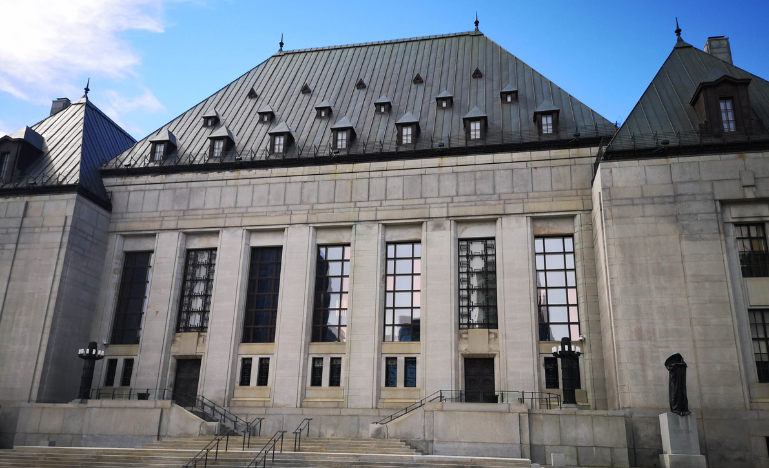
In a unanimous decision, the Supreme Court of Canada has upheld the reversal of a death declaration in the case of a Quebec man who was found to be alive and well, living in Iran.
In the process, the Court clarified the rules under the Civil Code of Quebec for when a judicial declaration of death can be annulled. Under the Code, if a person has been missing for a period of seven years, their family can apply for a judicial declaration of death. It also provides for what happens if that person is found to be still living, known as a “return.” This decision clarifies the rules and the necessary proof.
In the case at hand, Deborah Riddle’s spouse, Hooshang Imanpoorsaid disappeared in February of 2008 after saying he was leaving on a business trip to Toronto. A police investigation found he had never gone to the city, but allegedly flew to Amsterdam instead. It was later discovered he owed large sums of money to several lenders and had purportedly written a cryptic email to his children the day after he left home.
After he was absent for eight years, Riddle applied to the Quebec Superior Court to obtain a declaratory judgment of death. Facing the prospect of paying out a life insurance policy, the insurance provider, ivari, opposed, arguing Imanpoorsaid had fled the country. The trial judge said the circumstances of the disappearance could not prevent the issuance of the declaratory judgment and granted it. ivari applied to the court for an annulment, presenting new evidence that Imanpoorsaid had gone to Iran, but he had not been served. In light of this, the trial judge annulled the declaratory judgment of death, finding ivari had established Imanpoorsaid’s “return.”
This was upheld at the Quebec Court of Appeal.
Riddle appealed to the Supreme Court of Canada, arguing that two errors of law occurred. First, that the courts erred in finding that ivari’s failure to serve the proceedings for annulment to Imanpoorsaid did not lead to the dismissal of the proceeding. Second, the courts had erred in determining the applicable legal framework for proving a return, namely that it required unquestionable proof that the person is currently alive.
The Supreme Court unanimously dismissed the appeal, finding that the failure to serve the proceedings did not compromise the integrity of the judicial process. Further, there’s no specific threshold of certainty required to prove a return, other than that the evidence must be clear and convincing.
“While the physical presence of the person declared dead will always be the best proof that they are currently alive, a judge may be satisfied with evidence establishing that the person is still living, particularly where the circumstances suggest that their disappearance or reclusion is voluntary,” Chief Justice Richard Wagner wrote for the Court.
“Proof of return, therefore, does not require a different standard of proof. In Quebec civil law, unless the legislature specifies otherwise, the standard of proof remains the balance of probabilities.”
The decision also pointed to evidence presented to the trial judge that, in 2015, Iran’s state census organization personally delivered a national identity card to someone whose name matched Imanpoorsaid’s. Since his disappearance in 2008, two Iranian passports have been applied for, and each included his photo. There are records showing that between 2008 and 2017, Imanpoorsaid left and returned to Iran on at least 16 occasions, three of which were after the declaratory judgment of death was pronounced. In December 2018, he also applied for welfare in Iran, all of which satisfied the trial judge that he was still alive.
No payout of the $550,000 life insurance policy was made by ivari throughout the proceedings.
Riddle’s lawyer, Molly Krishtalka, a partner with Alexeev Attorneys LLP in Montreal, says that while the outcome was not what they hoped for, the ruling provides clarity on the portion of the absence and death regime in Quebec civil law that governs the return of a person declared dead.
“The meaning of the return of a person declared dead is not defined in the Civil Code of Quebec and has not been previously interpreted by the Supreme Court,” she says.
“Today’s judgment confirms the temporality of return—a declaratory judgment of death can only be annulled if there is evidence that the person declared dead is alive subsequent to the judgment.”
Wagner pointed out that the Code doesn’t permit reliance on evidence of life prior to the declaratory judgment of death to seek an annulment, which is an interpretation that reinforces legal certainty.
“Once a declaratory judgment of death is pronounced, it can be annulled only if there is evidence that the person declared dead is alive subsequent to the judgment,” he wrote.
“An action for annulment, therefore, cannot be regarded as a disguised appeal from the declaratory judgment of death, since it is based on the production of new and current evidence establishing that the non-present person is currently alive.”
Jasmine De Guise, a partner with Miller Thomson LLP in Montreal, says the decision sends a clear signal about how Canadian courts will balance legal certainty with factual reality in a globalized world, and reflects a modern understanding of disappearance, mobility, and deliberate absence.
“For insurers, the decision confirms that declaratory judgments of death are inherently provisional and may be revisited where credible evidence establishes that the insured is still alive, even without physical reappearance and even years later,” she says.
The Court’s firm rejection of any heightened standard of proof reinforces that insurers need only meet the civil test of balance of probabilities—with clear and convincing evidence–when challenging a legal presumption of death.
“For insureds and beneficiaries, the ruling underscores that rights flowing from a declaration of death, including life insurance benefits, are not immune from reversal if the underlying factual assumption proves false,” De Guise says.
“It affirms that the law will not allow legal fictions to prevail once reality is sufficiently demonstrated."